Why Your Training Budget Buys Applause and Amnesia
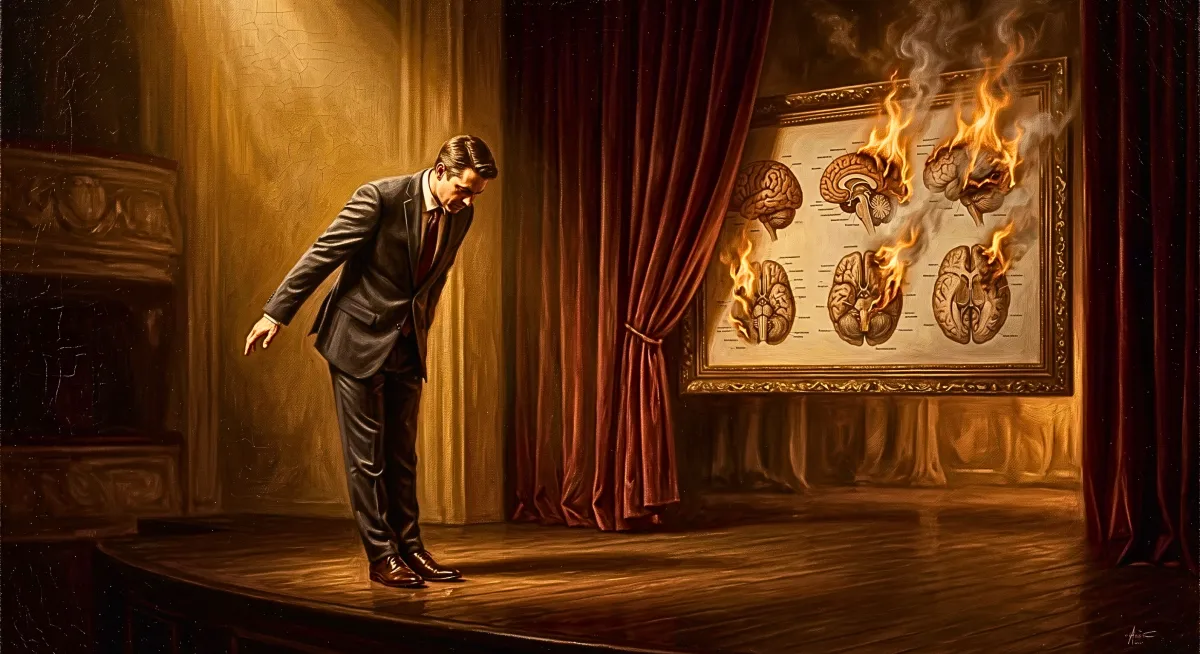
Corporate training is theater.
They buy training the way they buy catering, for the event, not the outcome. Applause is the deliverable. Amnesia is the acceptable byproduct because nobody in the purchase decision was going to measure “stickiness.”
When the people writing checks and the people doing the learning are separated by three layers of org chart, a fiscal quarter, and an ill-defined performance outcome, training gets designed for the check-writer.
This is not a vendor complaint. It's a market description.
The decision-makers want a packed room, a post-event Likert survey with fours and fives, a photo for the newsletter, and a line item — Leadership Development: Complete. The greatest concern was whether the event happened on time, on budget, with catering.
Everything downstream of this (the forgetting, the Monday-morning collapse, the quiet return to old workflows, the retraining six months later) is not a “training” failure.
You paid for theater, and you got your money’s worth.
“That’s outrageous! We take our training seriously!”
Humm…
Do you?
There is a non-mysterious body of learning science that predicts which training will stick and which will evaporate. The first learning retention study was written in 1885. Do you know what that study is? Who performed it? And what were the conclusions?
In the 1980s, and continuing to this day, there has been an avalanche of new research on the brain, how it learns, and how people change. None of it is secret.
Did your trainer du jour mention these studies and how they integrate the findings into their course design?
Again, this is not a vendor criticism. Corporate trainers are incentivized to ignore the learning science because designing around it would produce something check-writers wouldn't recognize as training.
“What do you mean there are no PowerPoints?”
“How in the hell can an advanced beginner teach a novice anything? Experts need to teach because they have authority and can keep the novice from making mistakes.”
Most educators are honest people who love the work, but the market rewards what it rewards.
Training budgets got gutted after 2020, procurement standardized on the cheapest thing that could still be called training, and the vendors who survived the cut were the ones who learned to deliver applause on schedule.
Here is the science on how we learn. It’s not a secret; it’s been public for decades. Take a look, and then ask yourself: was your last training session designed for your brain, or your procurement process?
Sixty percent is gone before lunch
Hermann Ebbinghaus introduced the forgetting curve in 1885, demonstrating that humans retain approximately 60% of new information within an hour if it is not reinforced, with the remaining portion vanishing within a week. For 140 years, this insight has been consistently verified, standing as the most dependable baseline in memory research.
Corporate training is a bet against the forgetting curve. A one-day seminar, a two-day offsite, a keynote with slides: These are all wagers that the brain will retain what it heard because the speaker was compelling and the room was “engaged.”
It is a wager they lose because the brain does not care about eloquence. The brain is running Ebbinghaus on the speaker's content in real time, and by the drive home, most of it is already gone.
There is a way to beat the curve, and it isn't better slides. In 2019, a study delivered to the 711th Human Performance Wing at Wright-Patterson Air Force Base measured content-knowledge scores across system-wide healthcare leadership cohorts at 72 hours, 30 days, and 90 days after a facilitated learning event. Scores did not decay. They rose — 24% to 40% above pre-class baseline at the 90-day mark.
Scores rose because the learners were not "remembering" class content. They were using tools the facilitated learning event installed. Most training is created to inform. Installing “Aha!” moments is a different design problem than the ubiquitous PowerPoint “training” deck. So it is no surprise that engineering “Aha!” moments produces different results.
4s and 5s on a Likert scale = applause.
Learning success measured at 90 days, on the job, in metrics the organization already tracks.
The person talking is the person learning
Let me introduce you to the "Protégé Effect" advanced by John F. Nestojko and colleagues in 2014.
They demonstrated that individuals prepping to teach others organized and retained information much better than those preparing for a test. Merely anticipating the need to clarify concepts triggers a distinct neurological framework.
Those of you in the clinical space will understand the power of “See one, do one, teach one.” This has been a bedside teaching structure for generations, and its last beat is the point. You watched, you performed, you now instruct. The instruction is where learning consolidates.
Every clinician reading this knows the moment they truly understood a procedure was the moment they had to walk someone else through it.
Corporate training inverts this learning dynamic: The facilitator talks and the room listens. The facilitator organized the material, anticipated objections, sequenced the ideas. The facilitator is the one who learned. The other brains in the room ran a passive process that Ebbinghaus will complete by Tuesday.
This is uncomfortable for buyers, who equate keynote speaker airtime with facilitator value. It is fatal for learners, who need the airtime themselves.
“Wait, are you saying trainers shouldn’t talk?”
Yes, I am.
Facilitator silence is not a stylistic choice. It is the mechanism. A well-designed learning event constrains how much the facilitator is permitted to talk because every minute the facilitator is talking is a minute the wrong brain is working.
If you leave a training thinking what a great speaker, you probably just watched a great speaker and the applause was the value proposition.
If you leave a training exhausted, drained, but your mind is firing with connections, you learned something.
Novices and experts are not in the same room
Patricia Benner published From Novice to Expert in 1984 (adapted from Hubert and Stuart Dreyfus Five Stage Model). Benner adapted the model for nursing education. The premise is simple: expertise is grown, not taught.
Learning occurs at a series of cognitive states, and each state needs a different kind of instruction.
A novice needs rules, context, and permission to follow the rules literally. A competent practitioner needs cases and pattern exposure. An expert needs a sparring partner. They need someone who can pressure-test their pattern recognition because this is faster than their deliberate choice to dissect their internal logic.
Put a novice and an expert in the same training, and you fail both.
The novice drowns in nuance. The expert checks out because trivialities bore them. Both leave the room with the same conclusion: this wasn't for me. Both are right.
Real learning events sort learners by their place on the Novice-to-Expert spectrum and design “Aha” moments tailored to vastly different learner needs.
You paid for a one-size-fits-all event, and what you get is one size fits none.
Speaking of Size (Because size does matter)
Every training vendor has a cohort size. As a rule, the size is, “We have the Zoom enterprise plan. We are the Kings of MOOC’s.”
At least one vendor is aware of this as a learning disaster. They pick their cohort size based on science.
The Floor = Hard 8
If you’ve got fewer than eight people, you lose that social spark needed to really push each other’s thinking. The vibe stays a little too polite. No one’s ideas get challenged hard enough to shift anything. Instead, it just feels like another small meeting—a routine the brain already knows how to coast through without learning a thing.
The Ceiling = Hard 24
Above twenty-four, a different failure mode kicks in. Pashler's 1994 work on the attentional bottleneck established that the brain, faced with too much simultaneous social input, defaults to a spectator posture — observing rather than participating. In a room of thirty-plus, the individual brain calculates that it can disappear. And it does. Not out of rudeness. Out of cognitive economy.
Eight to twenty-four is the band where every brain in the room has to stay on. Small enough that you will be called on. Large enough that the diversity of thought produces friction the facilitator could not manufacture alone. The cap is not a marketing preference. It is a load-bearing design decision, and violating it in either direction breaks the mechanism.
Eight to twenty-four is neurological, not marketing
Priming work is not busywork
We’ve all been sent the pre-read PDF nobody opens, the survey that feeds a slide the facilitator was going to show anyway.
We all know it is useless, so we ignore it. And we should.
But learners should not ignore a Priming Event.
Robert Gagné outlined nine instructional events, and the first 6 can be considered Priming: the interval where the rubric focuses the brain toward a specific learning outcome. This process must occur before a learner steps into the classroom, because it is the foundation on which the learning diagnostic rests.
Slamecka and Graf, in 1978, established the Generation Effect: material the learner generates themselves is retained better than what they are given.
Not slightly more durable.
Substantially.
The act of producing an answer — even a wrong one — primes the cognitive scaffolding to which the correct answer will later attach.
A priming event is generation practice.
They work best seven days before the in-person cohort and usually involve four interleaved actions, a maximum of fifteen minutes each, and the outcome is: “Be prepared to discuss your thoughts with your peers.”
By the time the participant walks into the room, their brain has already built the hooks on which the event insights will hang. The insights land differently because there is somewhere for them to land.
Lunch and Learn is a neurological oxymoron
Your prefrontal cortex is a gas-guzzler, and deep cognitive work burns through glucose so fast it leaves you physically wiped. It's not just in your head; it's your body paying the bill.
Deep learning is a metabolic drain. Add lunch to the mix, and you trigger "rest and digest"—the exact opposite of the focus you need. Your body can't do both at once, so it sabotages the learning to handle the digestion.
The alliteration is diabolical because it hides the reality that “Lunch and Learn” is a scheduling convenience sold as a pedagogical format. It exists because it fits inside a workday without requiring anyone to protect learning. The buyer likes it because it looks efficient. The vendor likes it because they get a paycheck and maybe a free lunch. Learners get a break from their routine and food on the corporate dime. But the brain treats it as an instruction to stop learning and start digesting.
You cannot beat this with better catering. You cannot beat it with lighter food: The autonomic system is not persuaded by a salad.
P.S. Vendors, why do you tolerate the insult? “Yes, yes, educate us, but can you do it while we do something really important?”
Zoom cannot manufacture communitas
Victor Turner’s concept of "communitas" (The Ritual Process, 1969) describes the unique bond formed when a group crosses a threshold together in the same room, under shared pressure. It’s not just networking; it’s a psychological shift that happens when people realize their collective experience changed them. It’s why high-impact experiences like bootcamps or first weeks on a job are so durable—shared physical presence does the heavy lifting that content alone can’t touch.
Zoom cannot produce this outcome because the mechanism requires embodied co-presence — shared physical space, shared physical fatigue, the peripheral vision of other people's faces registering the same insight at the same moment. The nervous system reads a video square as a representation of a person, not as a person. Communitas needs the real thing.
Everyone thought “Online Training” was a panacea because it was quicker, cheaper, and that made it better and faster.
When COVID hit, everyone dove headfirst into MOOC’s. Corporate budgets adjusted accordingly, slashing training budgets with Scrooge McDuck glee.
And now we are in 2026, and the only people who’ve not gotten the memo that online training is just awful are the same Scrooge McDucks, who only count success by the number of coins in the swimming pool.
If you pay for volume, you get amnesia (as the post-pandemic learning landscape readily attests). If you understand that in-person collective struggle is not a preference but a learning mechanism Victor Turner named forty years before Zoom existed, you will get performance.
The right kind of tired
Real learning wipes you out. It’s not just being bored; it’s a specific "good tired" that proves your brain did the heavy lifting. If you aren't metabolically drained after four hours of deep work, you probably weren't learning.
This exhaustion is a diagnostic signal. Recovery is mandatory. Your brain needs downtime to "write" that new info into long-term memory. Jumping into another meeting right after is a rookie mistake—it overwrites the progress before it can stick. To keep the gains, you have to protect the rest period.
Sitting through a lecture makes your body tired; an emotional keynote makes you feel "pumped"; but true learning leaves your mind firing while your body hits a wall. That’s the feeling of new neural pathways forming.
What the research says
Every one of these mechanisms is decades old. None of them are contested. Ebbinghaus is 140 years old, for crying out loud.
Benner is 40. Slamecka and Graf are almost 50. Pashler is 30. Nestojko is the newcomer at 11. Turner predates all the neuroscience and has been confirmed by it. This is not an emerging body of knowledge.
The question then is: Why is it being ignored by the very industry, paid to teach?
Because the training industry isn't paid to care about performance outcomes. They’re paid to put on a good show, to perform while you eat, like jesters at the king's banquet. They are paid to create "events" that look good on a calendar, not for the hard work of real change.
Leaders and decision makers, here is the choice before you.
Pretend you didn’t read this article and keep paying for applause and live with the inevitable amnesia.
OR
Ask these awkward questions.
Does the course design fight the forgetting curve?
Is the cohort small enough to matter?
Is there real pre-work, or just busywork?
Is the facilitator doing all the talking?
And most importantly: What is your performance outcome, and can it be measured at the 90-day mark?
Bad training is a total waste of money, so that alone should make it too expensive to consider. However, the much deeper crisis is that it’s a crime to waste your people's time. Human brains are too valuable for tedium and irrelevancies measured by a round of applause and a smiley-face Likert scale.
The applause is gone by the time they hit the parking lot, and the amnesia is already set in stone.

