Organizational Change Management Is a Grief Problem
You closed the last article “Your Change Initiative Failed Because You Trained for a Marathon and Made Everyone Else Sprint,” thinking organizational change was a training problem.
It isn't.
The leadership team didn’t give itself skills training. It looks like the executive team didn't attend the workshop on the new operating model.
What they gave themselves was eighteen months to face this reality: The thing they’d built, defended, and staffed was going to end because they were going to kill it.
By the time the organization-wide announcement email went out, the leadership team had already grieved. They didn’t know that was what they had done, but they all (those who chose to be on board with the change) moved through the stages of grief: denial, anger, bargaining, depression, and acceptance.
In the corporate world, this rarely gets named. So I will point out the thing staring you in the mirror.
You remember the leadership meetings? You remember the fights. You remember the bargaining and depression and eventually the tired looks of acceptance.
This was all grief.
And this is why the enthusiasm on the “Town Hall” webex was met with crickets. Leadership had crossed a threshold. Then they asked the rest of the organization to cross it in two weeks with a slide deck.
The three stages that matter
I hold a facilitated learning event called “Cause of Death: A murder-board investigation into why change initiatives don't make it out of the room alive.”
The title is not decorative.

This facilitated learning event is built around three stages. I did not invent them — the psychology of transition has been written about for fifty years. The existing models have five, seven, and eight stages, and in the classroom I watched adults nod politely at all of them and then fail at exactly three.
So I cut the model down to the three that are load-bearing, the ones you cannot skip without the change collapsing: End of World. The Desert. Promised Land.
End of World is the burning platform, and the brain has a specific requirement here that most change communications miss. The old world has to be credibly dead, not "evolving," not "being optimized."
Dead.
If the platform is still habitable, nobody leaves it. The reason so many transformation announcements fail is that they are written to reassure — we're building on our strengths, we're not throwing anything away. Reassurance tells the brain the old world is not that bad; we just need to make a few tweaks.
To which the brain says, “If it's ‘not that bad’, why put me in danger?”
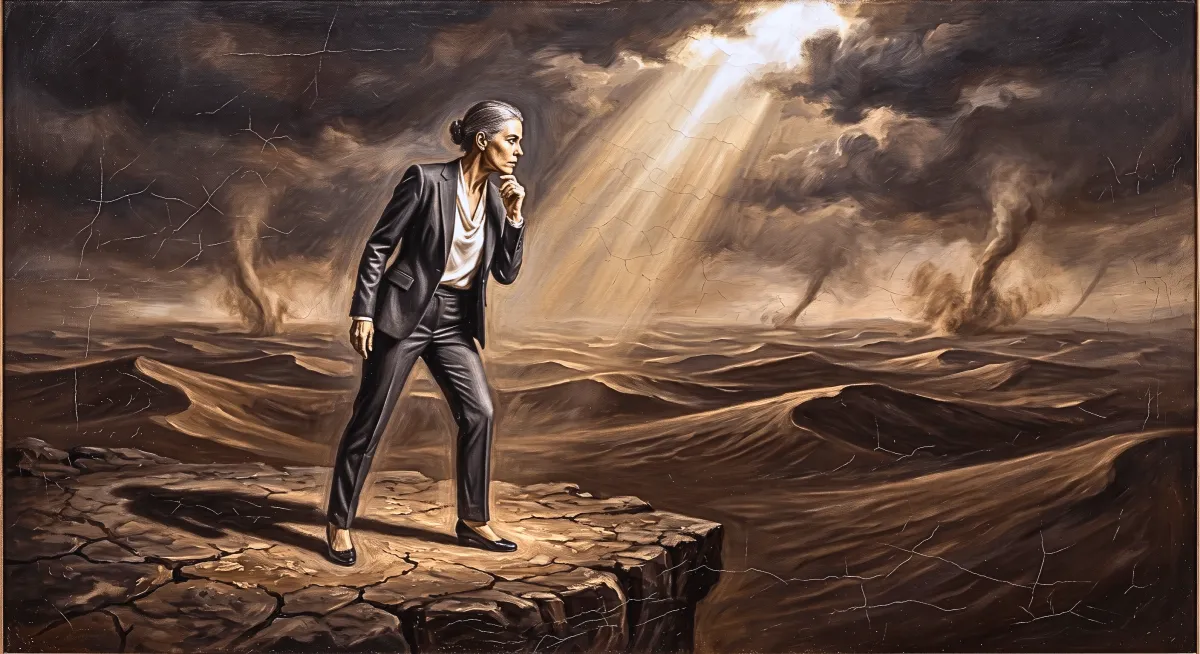
The Desert is where the work happens and where the initiative dies.
“I spent 20 years getting really good at this, and now I am just awful, and everyone can see how bad I am!”
This is the fear and frustration that every adult thinks but never voices. Adults are catastrophically bad at being a novice.
Children accept being novices because they have no identity to defend.
Adults have decades of competence and a cognitive model of themselves to protect. This is why you rarely see anyone in the C-suite in a computer class, or any class. They cannot risk appearing vulnerable when the organizational direction requires omnipotence.
And it only gets worse because there is no such thing as learning fast. Learning takes time, and there is no version of the desert where it doesn't
So the only choice is for everyone to move with purpose through the novice desert until conscious competence emerges.
Promised Land is where most change management frameworks quietly cheat.
They describe it as new skills, new capabilities, new ways of working — which is a lie that lets the reader off the hook.
Promised Land is not a skill. It is a new identity. The person on the other side of a real change is not a better-trained version of who they were.
They are someone different.
Skill acquisition is bounded; identity change is not.
This is why real change feels like loss even when it ends well. Something on the other side of the desert isn't you anymore.
Grief is the mechanism
Grief is load-bearing. Not humane. Not thoughtful. Load-bearing. Without it, the novice desert cannot be crossed, and people retreat to the “not so bad” burning platform every time.
The reason is mechanical. The desert is unbearable on its own terms — you're bad at things, you're publicly incompetent, the work is harder than the glossy brochure told you.
But this psychological (and professional) awfulness is amplified because you left the old world without saying goodbye. Now the desert reads as punishment.
Punishment for what?
For a change you never agreed to, mourning a loss you were never permitted to name.
So people do what any punished person does. They go home. Home is the old system, the old process, the old identity — the regression the change plan never accounted for. They go back to the shadow workflow that keeps running underneath the new one, the meeting that gets scheduled to work around the tool nobody adopted.
The pattern is old. The most catastrophic change initiative in recorded history — the Children of Israel, forty years in the wilderness, a generation dying before the Promised Land — was a grief failure at scale.
A population was told their world was over without ever being permitted to mourn it. When the pressure of the desert became unbearable, they reached for what they had known before. The story is usually read as disobedience, but maybe it is something else, something worth its own conversation.
But for this article, it is important to note that organizations get through the desert one of two ways: they turn over their workforce like the generation dropping in the wilderness, or they let people mourn on the way in and give permission to be a novice.
Stick figures and funerals
In the “Cause of Death: A murder-board investigation …” learning event, we have two pivotal evolutions. The first is a funeral. We hold funerals in class for change projects that died — real ones, from the participants' own careers.
We pause. People say nice words about the project, what it was trying to do. Who worked on it. Why it mattered. Why it failed, then we grieve it, out loud, together.
This is not theater, and it is not a team-building exercise.
If it reads as either, it fails, and I have seen it fail when a facilitator treats it lightly.
It works because it is serious. The funeral gives adults a rehearsal — a first, small, safe experience of feeling psychological pain about a work thing and surviving it. Once they have grieved a dead project in a classroom, they can anticipate the grief of a live change instead of being ambushed by it. The desert stops being punishment. It becomes the part of the journey they were told about.
The second evolution: Adults draw their own change in three panels of stick figures: who they were, who they had to become, and the desert in between.
I have run this exercise with executives, mid-career specialists, career-changers, and new managers. They draw the desert bigger and more complex every time.
That is not a drawing error. That is the implicit truth about change come to life from their subconscious, rendered by people who have been through it and are no longer lying to themselves about the size of the middle.

What this looks like in an actual organization
You cannot run a stick-figure exercise for ten thousand employees. That is not the prescription.
The prescription is this. Before you announce the new operating model, hold the funeral for the old one. Name what is being lost — not the inefficiencies, the good things. The team that will be broken up did real work; say what it was. The process being retired solved a real problem when it was built; say what it solved. The identity people are being asked to set down was earned; say how it was earned. Then say, out loud, that it is over.
If your leadership team cannot do this — if the eulogy for the old model sounds like a press release, if you cannot bring yourself to say what was good about the thing you are killing — you have not finished grieving it yourself.
Go finish.
The organization will not cross a desert on behalf of a leadership team that hasn't crossed its own.
If you can do it, and you do, the people who work for you will still find the desert brutal. They will still be bad at the new thing for longer than the plan assumed. But they will know what the desert is, and they will know they are allowed to feel what they are feeling, and they will not retreat.
If you won't do it, and you won't finish your own grief, and you won't give the organization theirs — stop being surprised when the adoption dashboard flatlines. You didn't fail at communication. You failed at the funeral.

